
For businesses and industry
A stable energy cost for your site
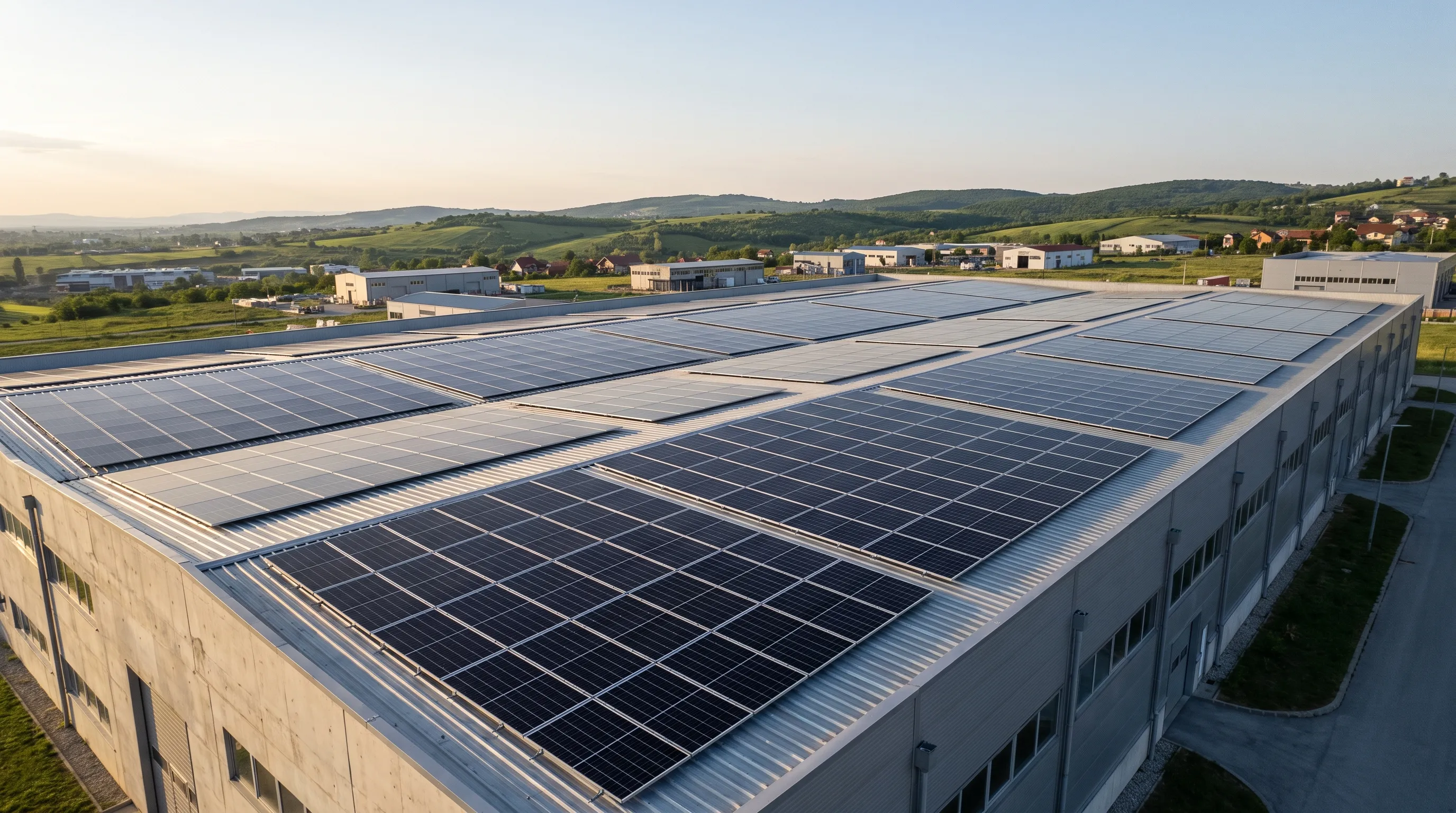
Solar power systems up to 250+ kW for manufacturing sites, halls and warehouses. Most cost-effective for businesses running one or two shifts, where the site uses electricity exactly while the system is producing it.
Why now
Four reasons industry is building power systems
Rising electricity prices
Electricity prices for businesses have been rising over the long term. Your own production fixes the cost of most of your consumption for 25+ years.
Predictable costs
The system produces at a known cost per kWh. Energy budgeting stops depending on your supplier's pricing decisions.
Investment loans
Banks in Serbia offer dedicated loans for renewable energy - the installment is typically covered by the savings achieved.
ESG and export customers
More and more international partners require proof of green energy in the supply chain. Your own power system is a measurable, verifiable answer.
Our methodology
Sizing from 12 months of electricity bills
Send us a full year of bills and we return a quotation in 2-3 days.
Why one bill is misleading
One bill is a snapshot of a single month. It doesn't show seasonality (summer vs. winter), it doesn't show the ratio of peak to off-peak tariffs, and it doesn't show whether consumption tracks production cycles or heating. A system sized from a snapshot only gets it right by chance.
What 12 bills reveal
- → your real annual consumption, month by month
- → seasonal swings and peak loads
- → the ratio of daytime to nighttime consumption
- → how much of the production you can use yourself
What you get
- → a correctly sized system: no wasted capital (oversized) and no missed savings (undersized)
- → a savings simulation from your own data, not from averages
- → a quotation within 2-3 days of receiving your bills
What we do
Turnkey - literally
Six steps, one point of contact. You don't coordinate contractors - you sign and track progress.
01
Consumption analysis
12 months of electricity bills → your real annual profile: seasonality, tariff ratio, load shape.
02
Design and savings simulation
A system sized to your profile, with a production simulation and an honest payback calculation.
03
Equipment procurement
Trina Solar panels, Huawei inverters - tier-1 equipment with factory warranties and service support.
04
Installation by our own crews
Including steel structures and canopies we manufacture ourselves (EN 1090, ISO 3834).
05
Grid-connection procedure
Connection request, technical conditions, contract, technical acceptance - we manage all of it.
06
Service and maintenance
Production monitoring, periodic checks and a maintenance contract after commissioning.
Engineering background
The structure holding up your roof-mounted system is one we manufacture ourselves
IC Solar isn't a panel reseller. Behind every power plant is a mechanical-electrical engineering company with its own steel structure production, certified welders and 24 years of industrial projects.
Certifications
- ISO 9001 Sistem menadžmenta kvalitetom
- ISO 14001 Upravljanje zaštitom životne sredine
- ISO 45001 Bezbednost i zdravlje na radu
- EN 1090 Proizvodnja čeličnih konstrukcija
- EN ISO 3834 Kvalitet u zavarivanju
Engineering licenses
- 332
- 333
- 432
- 434
Licensed designers and contractors for electrical and mechanical installations.
Welding qualifications
- MIG/MAG
- TIG
- GW
In-house steel structure production to EN 1090 - no subcontractors.
Honestly
Solar isn't for everyone - and we'll tell you upfront
A system pays off best when production overlaps with consumption. Businesses that use electricity during the day - manufacturing sites, cold storage, processing - get the shortest payback.
The most common misconception: "half the capacity = half the bill"
If a system covers 50% of your connected capacity, your bill doesn't automatically drop by half. You save directly only on the electricity you use while the system is producing - any surplus goes to the grid under a less favorable calculation. That's why savings aren't calculated from capacity, but from how well your consumption profile overlaps with production. And that's why we ask for 12 months of bills before quoting any figure.
Ideal profile
- ✓ a manufacturing site with a first (and second) shift
- ✓ 12 months of bills that show your real consumption
- ✓ a hall roof or space for a canopy / ground-mounted installation
- ✓ consumption mostly during the day, year-round
Less cost-effective
- ✗ consumption mostly at night or on weekends
- ✗ a property used only seasonally
If our analysis shows a system won't pay off for you, we'll tell you that too.
Industrial references of IC Systems Automatika




New
Solar carports for your car park
Covered parking that generates power at the same time: parking for staff, for the fleet and for visitors, combined with solar production, battery storage and EV charging. The steel structure comes out of our own production, like every other structure we build.
Configured per property, price on request.
Questions businesses ask
Why do you ask for 12 monthly bills, not one?
One bill is a snapshot of a single month - it doesn't show seasonal swings or your load profile. From 12 bills we read your real annual consumption, the ratio of peak to off-peak tariffs, and seasonality. That's the difference between a guess and a calculation: a system sized from an annual profile is neither oversized (wasted capital) nor undersized (missed savings).
What system size is realistic for our site?
The most cost-effective projects are typically 150-250 kW, but we build considerably smaller systems too. A concrete answer comes from analyzing your bills - we size the system to your daily consumption, not to your roof area or connected capacity.
Can our roof carry a power system?
We verify that during the site visit. Our advantage is that we are a mechanical-electrical engineering company with our own steel structure production (EN 1090): if reinforcement or a canopy is needed, we design and build it ourselves, without subcontractors.
Who manages the grid-connection procedure?
We do. The complete communication with the grid operator - the request, technical conditions, contracting, technical acceptance - is part of the turnkey service. You sign, we handle the paperwork.
What happens to surplus electricity produced?
Surplus is fed into the grid and settled under the applicable model for customer-producers. Since the settlement for surplus is less favorable than direct savings, the goal of sizing is to maximize the share of production you consume yourself - another reason we design the system from your real consumption profile.
How is a solar power system maintained?
The system has no moving parts and needs little maintenance: periodic visual and electrical checks and panel cleaning as needed. We offer a service and maintenance contract, and you track production through the monitoring app.
Next step
Send an inquiry
Leave your contact details and basic information - we'll ask for 12 months of bills after the first conversation.
How much would a power system save at your site?
Send us your electricity bills for the last 12 months and your site location - you will get a quotation with a savings simulation in 2-3 days.